Reduction of order
Reduction of order[edit]
Differential equations can usually be solved more easily if the order of the equation can be reduced.
Reduction to a first-order system[edit]
Any explicit differential equation of order n,

can be written as a system of n first-order differential equations by defining a new family of unknown functions

for i = 1, 2,..., n. The n-dimensional system of first-order coupled differential equations is then
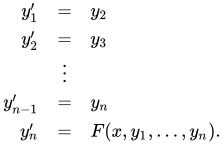
more compactly in vector notation:
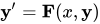
where

Summary of exact solutions[edit]
Some differential equations have solutions that can be written in an exact and closed form. Several important classes are given here.
In the table below, P(x), Q(x), P(y), Q(y), and M(x,y), N(x,y) are any integrable functions of x, y, and b and c are real given constants, and C1, C2, ... are arbitrary constants (complex in general). The differential equations are in their equivalent and alternative forms that lead to the solution through integration.
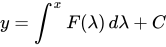
In the integral solutions, λ and ε are dummy variables of integration (the continuum analogues of indices in summation), and the notation ∫x F(λ) dλ just means to integrate F(λ) with respect to λ, then after the integration substitute λ = x, without adding constants (explicitly stated).
Separable equations[edit]
| Differential equation | Solution method | General solution |
|---|---|---|
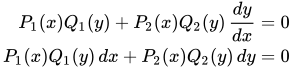
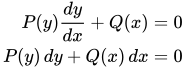
| First-order, separable in x and y (general case, see below for special cases)[27] | Separation of variables (divide by P2Q1). | |
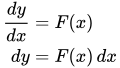
| First-order, separable in x[25] | Direct integration. | |
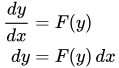
| First-order, autonomous, separable in y[25] | Separation of variables (divide by F). | |
| First-order, separable in x and y[25] | Integrate throughout. |



General first-order equations[edit]
| Differential equation | Solution method | General solution |
|---|---|---|
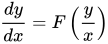
| First-order, homogeneous[25] | Set y = ux, then solve by separation of variables in u and x. | |
| First-order, separable[27] | Separation of variables (divide by xy). | If N = M, the solution is xy = C. |
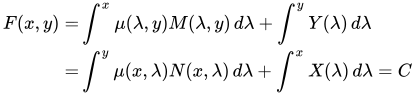
| Exact differential, first-order[25] where | Integrate throughout. | where and |
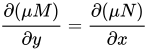
| Inexact differential, first-order[25] where | Integration factor μ(x, y) satisfying | If μ(x, y) can be found in a suitable way, then where and |
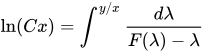
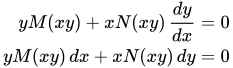
![{\displaystyle \ln(Cx)=\int ^{xy}{\frac {N(\lambda )\,d\lambda }{\lambda [N(\lambda )-M(\lambda )]}}}](https://wikimedia.org/api/rest_v1/media/math/render/svg/ef860b95a78299857b7025649deb3e6e30504c74)
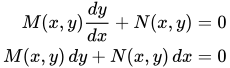

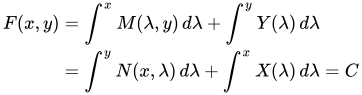





General second-order equations[edit]
| Differential equation | Solution method | General solution |
|---|---|---|
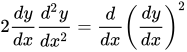
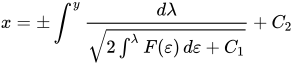
| Second-order, autonomous[28] | Multiply both sides of equation by 2dy/dx, substitute , then integrate twice. |



Comments
Post a Comment