odrinary diffential equation
General definition[edit]
Given F, a function of x, y, and derivatives of y. Then an equation of the form

is called an explicit ordinary differential equation of order n.[8][9]
More generally, an implicit ordinary differential equation of order n takes the form:[10]

There are further classifications:
- Autonomous
- A differential equation not depending on x is called autonomous.
- Linear
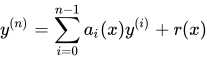
- A differential equation is said to be linear if F can be written as a linear combination of the derivatives of y:
- Homogeneous
- If r(x) = 0, and consequently one "automatic" solution is the trivial solution, y = 0. The solution of a linear homogeneous equation is a complementary function, denoted here by yc.
- Nonhomogeneous (or inhomogeneous)
- If r(x) ≠ 0. The additional solution to the complementary function is the particular integral, denoted here by yp.
- Non-linear
- A differential equation that cannot be written in the form of a linear combination.
System of ODEs[edit]
A number of coupled differential equations form a system of equations. If y is a vector whose elements are functions; y(x) = [y1(x), y2(x),..., ym(x)], and F is a vector-valued function of y and its derivatives, then

is an explicit system of ordinary differential equations of order n and dimension m. In column vector form:
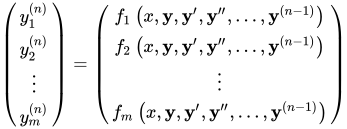
These are not necessarily linear. The implicit analogue is:

where 0 = (0, 0, ..., 0) is the zero vector. In matrix form
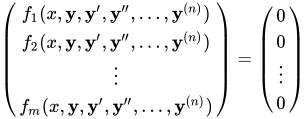
For a system of the form , some sources also require that the Jacobian matrix be non-singular in order to call this an implicit ODE [system]; an implicit ODE system satisfying this Jacobian non-singularity condition can be transformed into an explicit ODE system. In the same sources, implicit ODE systems with a singular Jacobian are termed differential algebraic equations (DAEs). This distinction is not merely one of terminology; DAEs have fundamentally different characteristics and are generally more involved to solve than (nonsingular) ODE systems.[14][15][16] Presumably for additional derivatives, the Hessian matrix and so forth are also assumed non-singular according to this scheme,[citation needed] although note that any ODE of order greater than one can be (and usually is) rewritten as system of ODEs of first order,[17] which makes the Jacobian singularity criterion sufficient for this taxonomy to be comprehensive at all orders.


The behavior of a system of ODEs can be visualized through the use of a phase portrait.
Solutions[edit]
Given a differential equation
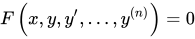
a function u: I ⊂ R → R, where I is an interval, is called a solution or integral curve for F, if u is n-times differentiable on I, and

Given two solutions u: J ⊂ R → R and v: I ⊂ R → R, u is called an extension of v if I ⊂ J and

A solution that has no extension is called a maximal solution. A solution defined on all of R is called a global solution.
A general solution of an nth-order equation is a solution containing n arbitrary independent constants of integration. A particular solution is derived from the general solution by setting the constants to particular values, often chosen to fulfill set 'initial conditions or boundary conditions'.[18] A singular solution is a solution that cannot be obtained by assigning definite values to the arbitrary constants in the general solution.[19]
In the context of linear ODE, the terminology particular solution can also refer to any solution of the ODE (not necessarily satisfying the initial conditions), which is then added to the homogeneous solution (a general solution of the homogeneous ODE), which then forms a general solution of the original ODE. This is the terminology used in the guessing method section in this article, and is frequently used when discussing the method of undetermined coefficients and variation of parameters.
Solutions of finite duration[edit]
For non-linear autonomous ODEs it is possible under some conditions to develop solutions of finite duration,[20] meaning here that from its own dynamics, the system will reach the value zero at an ending time and stays there in zero forever after. These finite-duration solutions can't be analytical functions on the whole real line, and because they will being non-Lipschitz functions at their ending time, they don´t stand uniqueness of solutions of Lipschitz differential equations.
As example, the equation:

Admits the finite duration solution:



Comments
Post a Comment