The energy method
The energy method[edit]
The energy method is a mathematical procedure that can be used to verify well-posedness of initial-boundary-value-problems.[2] In the following example the energy method is used to decide where and which boundary conditions should be imposed such that the resulting IBVP is well-posed. Consider the one-dimensional hyperbolic PDE given by
![{\displaystyle {\frac {\partial u}{\partial t}}+\alpha {\frac {\partial u}{\partial x}}=0,\quad x\in [a,b],t>0,}](https://wikimedia.org/api/rest_v1/media/math/render/svg/cba9b9bfb3028cc78a61bac020ded390a6615292)
where is a constant and is an unknown function with initial condition . Multiplying with and integrating over the domain gives


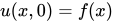


Using that


Here denotes the standard norm. For well-posedness we require that the energy of the solution is non-increasing, i.e. that , which is achieved by specifying at if and at if . This corresponds to only imposing boundary conditions at the inflow. Note that well-posedness allows for growth in terms of data (initial and boundary) and thus it is sufficient to show that holds when all data are set to zero.


Existence of local solutions[edit]
The Cauchy–Kowalski theorem for Cauchy initial value problems essentially states that if the terms in a partial differential equation are all made up of analytic functions and a certain transversality condition is satisfied (the hyperplane or more generally hypersurface where the initial data are posed must be noncharacteristic with respect to the partial differential operator), then on certain regions, there necessarily exist solutions which are as well analytic functions. This is a fundamental result in the study of analytic partial differential equations. Surprisingly, the theorem does not hold in the setting of smooth functions; an example discovered by Hans Lewy in 1957 consists of a linear partial differential equation whose coefficients are smooth (i.e., have derivatives of all orders) but not analytic for which no solution exists. So the Cauchy-Kowalevski theorem is necessarily limited in its scope to analytic functions.


Comments
Post a Comment